
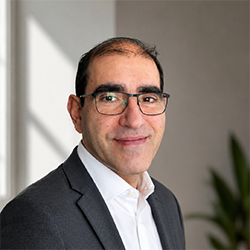
Francesc Purroy Martin was born in Barcelona, Catalunya, Spain, in 1965. He received the telecommunication engineer degree in 1989 and the doctor degree in 1996, both from the Polytechnic University of Catalonia (UPC). In 1997, he joined Ericsson Radio Access AB in Kista, Stockholm, Sweden working as Senior Specialist. Since 2006 he works in Huawei Technologies Sweden as Wireless Chief Expert and as Power Amplifier Team Leader. His current research interests include high efficiency wideband power amplifier architectures and non-linear transistor characterization measurement and modelling techniques.
Abstract:
Title: Power Amplifier Technologies for Radio Base Stations
The mobile base-station industry is under relentless pressure: deliver higher data rates across denser networks while simultaneously cutting operational expenses (OpEx). For power amplifier (PA) R&D teams, these demands create a perfect storm of technical challenges.
Rising energy prices—especially electricity costs for radio base stations (RBS)—combined with the need for greater capacity and coverage, have put PA energy consumption center stage. Yet traffic statistics reveal that most RBS operate at large back-off power levels, only reaching peak output during brief traffic surges. To minimize average energy consumption, we must therefore optimize PA efficiency precisely in those large back-off regions.
But energy efficiency is only part of the story. Application-specific requirements add further complexity:
- Large cells with Remote Radio Units (RRUs): Space is constrained. Operators want a single RRU to support multiple bands concurrently. This demands higher average output power and wider RF bandwidths.
- Smaller cells with Active Antenna Units (AAUs): Here, capacity is king. The large number of transmitters drives up cost, size, and power consumption. Linearization system costs become critical, placing self-linearity high on the PA requirement list.
This keynote will explain how Huawei’s PA department addresses these conflicting market demands. After clarifying the system requirements, the talk will shift to the specific research directions we are now pursuing—from novel architectures to efficiency-boosting techniques—to build the next generation of base-station power amplifiers.